Tuesday, March 20, 2018

Moving Up is More Affordable Now Than Almost Any Other Time in 40 Years

Moving Up is More Affordable Now Than Almost Any Other Time in 40 Years


If you are considering selling your current home, to either move up to a larger home or into a home in an area that better suits your current family needs, great news was just revealed.
Last week, Trulia posted a blog, Not Your Father’s Housing Market, which examined home affordability over the last 40+ years (1975-2016). Their research revealed that:
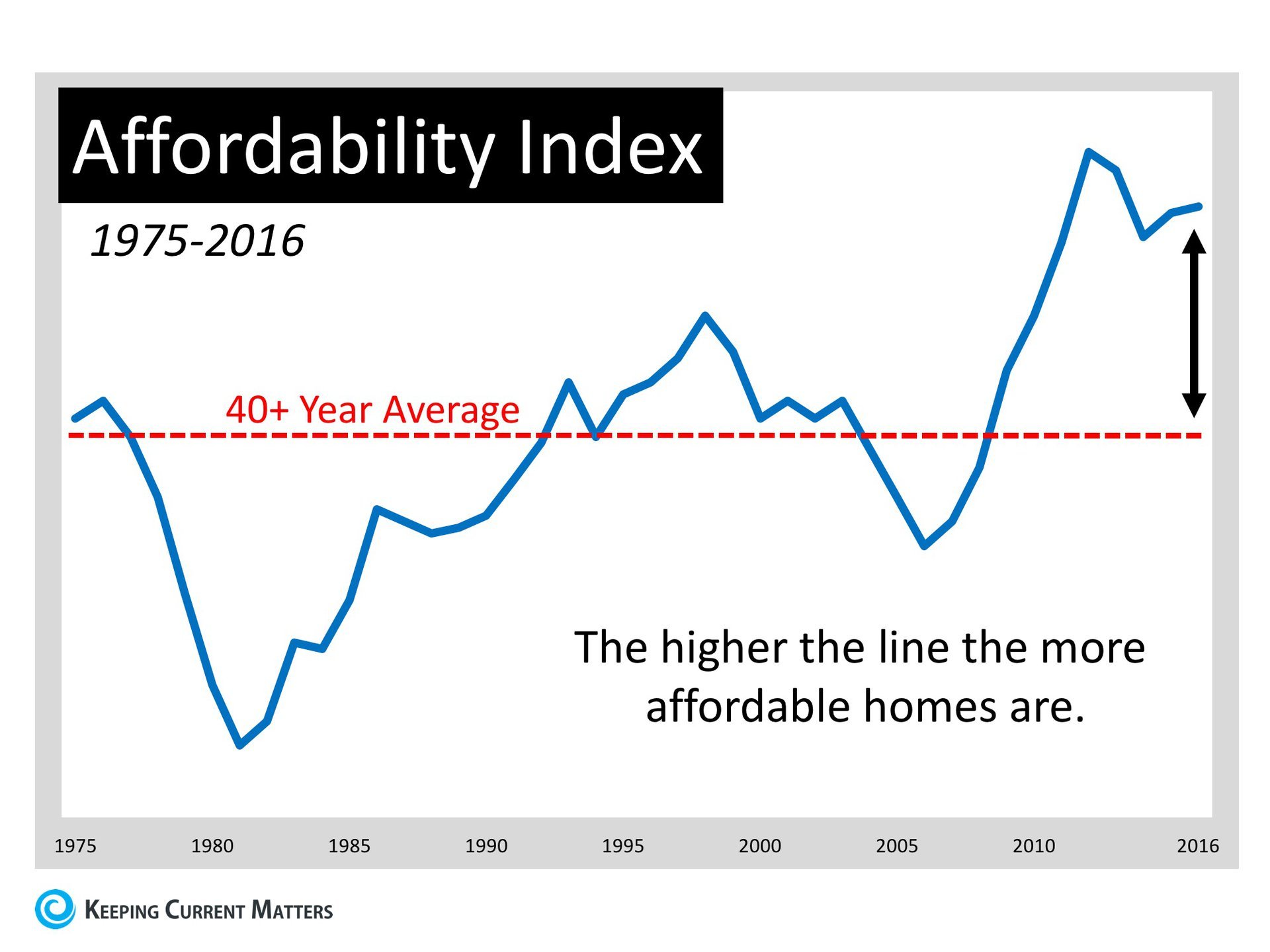
“Nationally, homes are just about the most affordable they’ve been in the last 40 years… the median household could afford a home 1.5 times more expensive than the median home price. In 1980, the median household could only afford about 3/4 of the median home price.
Despite relatively stagnant incomes, affordability has grown due to the sharp drop in mortgage rates over the last 30 years – from a high of over 16% in the 1980s to under 4% by 2016.
Of the nation’s 100 largest metros, only Miami became unaffordable between 1990 and 2016. Meanwhile, 22 metros have flipped from being unaffordable to becoming affordable in that same time frame.”
Here is a graph showing the Affordability Index compared to the 40-year average:
Moving up Is MORE Affordable Now Than Almost Any Other Time in 40 Years | Keeping Current Matters

The graph shows that housing affordability is better now than at any other time in the last forty years, except during the housing crash last decade. 

(Remember that during the crash you could purchase distressed properties – foreclosures and short sales – at 20-50% discounts.)
There is no doubt that with home prices and mortgage rates on the rise, the affordability index will continue to fall. That is why if you are thinking of moving up, you probably shouldn’t wait.

Bottom Line

If you have held off on moving up to your family’s dream home because you were hoping to time the market, that time has come.

Tuesday, October 17, 2017

Construction to Begin on $125M Health Campus in Scottsdale


Construction to begin on $125M health campus in Scottsdale

Article originally posted on Phoenix Business Journal on October 8, 2017
Construction is expected to begin this fall on a 43-acre, mixed-use campus at Loop 101 and 90th Street in Scottsdale.
Phase I of the project will include luxury assisted living, skilled nursing, medical office, retail, hotel and parking — and cost about $125 million to develop.
Smith Development/C.D. Smith Construction will provide construction services, while Plunkett Raysich Architects will provide design services. Both companies are based in Milwaukee, Wisconsin.
Los Angeles-based CBRE Group Inc. (NYSE:CBG) has been retained for leasing of the Sierra Bloom Wellness Campus.
The first phase will encompass about 300,000 square feet and will include:
• 71,000-square-foot, 120-bed behavioral health hospital
• 125,000-square-foot, 118-unit luxury assisted living and memory care community
• 120-room hotel
• 90,000-square-foot multi-specialty office building
• 50,000-square-foot skilled nursing facility
• 2,500-square-foot national quick service restaurant
• 6,000-square-foot national convenience store
“There is tremendous demand in Scottsdale for a high-end health and wellness destination and our first phase beginning in the fall will lift this project off the ground after many years of anticipation,” said Joshua Teague, Senior Vice President with Chicago-based Healthcare Development Partners, who leads the project along with Phoenix-based venture partner Pima Centre. “Merging best-in-class operators from multiple cross-sections of the continuum of care is the essence of Sierra Bloom, and we’re pleased to be bringing the vision to fruition.”
Vince Femiano and Kate Morris with CBRE’s Phoenix office will lease the balance of healthcare space on the Sierra Bloom campus while Zachary Pace with Phoenix Commercial Advisors has been retained for the retail leasing portion of the campus.
The property is owned by Salt River Pima Maricopa Indian Community and is under a long-term ground lease to Pima Centre LC, a joint venture between Healthcare Development Partnrs and Grosvenor Holdings in Phoenix, said Femiano.

Tuesday, September 26, 2017

Why Are So Few Homes For Sale?

Why Are So Few Homes For Sale?


Why Are So Few Homes for Sale?
There is no doubt that the largest challenge in today’s housing market is a lack of housing inventory for sale. This challenge has been defined as an “overwhelming lack of supply,” and even a “straight up inventory crisis.”
First American just released the results of a survey which sheds light on the reasons for the current lack of supply.
The survey asked title agents and real estate professionals to identify what they believe are the top reasons for this lack of inventory in their markets. Here are the results of the survey:
  • 47% – existing homeowners are worried that they will not be able to find a home to buy
  • 26.5% – first-time buyer demand is absorbing a large share of available homes
  • 11.3% – existing homeowners’ mortgage rates are lower than the current rates
  • 10.6% – insufficient or negative equity in the home
  • 4.6% – foreign buyer demand is absorbing a large share of available homes
As the survey revealed, there is a shortage of current homeowners willing to put their homes on the market for one of three reasons (see numbers 1, 3 and 4 above).

Is this an opportunity for some homeowners?

The report on the survey explains:
“The crowd has spoken, and it seems in many markets home buyers and sellers alike are ‘imprisoned’ by the lack of housing inventory.”
That leaves a tremendous opportunity for every homeowner not facing these concerns. If you can put your home on the market today, you are subject to far less competition than at any time in recent history. That will result in your home selling quickly and for the highest possible price.

Bottom Line

While many homeowners are feeling imprisoned for multiple reasons, those who are not handcuffed by these concerns have a once in a lifetime opportunity to sell their houses at a peak selling time.

Tuesday, August 22, 2017

58% of Homeowners See A Drop In Home Values Coming

According to the recently released Modern Homebuyer Survey from ValueInsured, 58 percent of homeowners think there will be a “housing bubble and price correction” within the next 2 years.
After what transpired just ten years ago, we can understand the concern Americans have about the current increase in home prices. However, this market has very little in common with what happened last decade.

The two major causes of the housing crash were:

  1. A vast oversupply of housing inventory caused by home builders building at a pace that far exceeded historical norms.
  2. Lending standards that were so relaxed that unqualified buyers could easily obtain financing thus enabling them to purchase a home.
Today, housing inventory is at a 20-year low with new construction starts well below historic norms and financing a home is anything but simple in the current mortgage environment. The elements that precipitated the housing crash a decade ago do not exist in today’s real estate market.
The current increase in home prices is the result of a standard economic equation: when demand is high and supply is low, prices rise.
If you are one of the 58% of homeowners who are concerned about home values depreciating over the next two years and are hesitant to move up to the home of your dreams, take comfort in the latest Home Price Expectation Survey.
Once a quarter, a nationwide panel of over one hundred economists, real estate experts and investment & market strategists are surveyed and asked to project home values over the next five years. The experts predicted that houses would continue to appreciate through the balance of this year and in 2018, 2019, 2020 and 2021. They do expect lower levels of appreciation during these years than we have experienced over the last five years but do not call for a decrease in values (depreciation) in any of the years mentioned.

Bottom Line

If you currently own a home and are thinking of moving-up to the home your family dreams about, don’t let the fear of another housing bubble get in the way as this housing market in no way resembles the market of a decade ago.

Friday, March 24, 2017

Urban Living in Phoenix is on Sale!

Contour on Campbell Ave. is on sale for a limited time! This is urban living at it's finest. Walk, bike or Uber to a large number of restaurants and shops. Call me to schedule a showing today! 
623-225-9482


Tuesday, February 14, 2017

Lack of Homes for Sale Slowing Down the Housing Market


The housing crisis is finally in the rear-view mirror as the real estate market moves down the road to a complete recovery. Home values are up. Home sales are up. Distressed sales (foreclosures and short sales) have fallen dramatically. It seems that 2017 will be the year that the housing market races forward again.
However, there is one thing that may cause the industry to tap the brakes: a lack of housing inventory. While buyer demand looks like it will remain strong throughout the winter, supply is not keeping up.

Here are the thoughts of a few industry experts on the subject:

National Association of Realtors

“Total housing inventory at the end of December dropped 10.8%...which is the lowest level since NAR began tracking the supply of all housing types in 1999. Inventory has fallen year-over-year for 19 straight months and is at a 3.6-month supply at the current sales pace.” 

Jonathan Smoke, Chief Economist for Realtor.com

“More than two-thirds of the markets are seeing less inventory now compared to a year ago.” 

Lawrence Yun, Chief Economist at NAR:

“The dismal number of listings in the affordable price range is squeezing prospective first-time buyers the most. As a result, young households are missing out on the wealth gains most homeowners have accrued from the 41% cumulative rise in existing home prices since 2011.” 

Sam Khater, Deputy Chief Economist at CoreLogic

“The lack of affordable supply is really driving up home prices.” 

Peter Muoio, Chief Economist at Auction.com

“Tight housing inventory remains a constraining factor limiting stronger sales growth…
We expect further price growth to entice more homeowners to list their homes, particularly as existing homeowners have greater equity.”

Bottom Line 

If you are thinking of selling, now may be the time. Demand for your house will be strong at a time when there is very little competition. That could lead to a quick sale for a really good price.

Thursday, January 26, 2017

Latest Fireside at Desert Ridge Homes For Sale

Click on the link below to view the latest Fireside at Desert Ridge homes for sale. There is a wide range of home prices offered starting from $292k - $810k. Together we are sure to find the right home for you.

Fireside at Desert Ridge Listings

Saturday, January 21, 2017

Is This the Year to Move Up to Your Dream Home? If So, Do it Early


It appears that Americans are regaining faith in the U.S. economy. The following indexes have each shown a dramatic jump in consumer confidence in their latest surveys:
  1. The University of Michigan Consumer Sentiment Index
  2. National Federation of Independent Businesses' Small Business Optimism Index
  3. CNBC All-America Economic Survey
  4. The Conference Board Consumer Confidence Survey
It usually means good news for the housing market when the country sees an optimistic future. People begin to dream again about the home their family has always wanted, and some make plans to finally make that dream come true.
If you are considering moving up to your dream home, it may be better to do it earlier in the year than later. The two components of your monthly mortgage payment (home prices and interest rates) are both projected to increase as the year moves forward, and interest rates may increase rather dramatically. Here are some predictions on where rates will be by the end of the year:

HSH.com:

“We think that conforming 30-year fixed rates probably make it into the 4.625 percent to 4.75 percent range at some point during 2017 as a peak.”

Svenja Gudell, Zillow’s Chief Economist:

“I wouldn’t be surprised if the 30-year fixed mortgage rate hits 4.75 percent.”

Mark Fleming, the Chief Economist at First American:

“[I see] mortgage rates getting much closer to 5 percent at the end of next year.”

Lawrence Yun, NAR Chief Economist:

“By this time next year, expect the 30-year fixed rate to likely be in the 4.5 percent to 5 percent range.”

Bottom Line

If you are feeling good about your family’s economic future and are considering making a move to your dream home, doing it sooner rather than later makes the most sense.

Tuesday, January 10, 2017

Millionaire to Millennials: Buy a Home!!


Last week, CNBC ran an article quoting self-made millionaire David Bach explaining that not purchasing a home is "the single biggest mistake millennials are making" because buying real estate is "an escalator to wealth.”
Bach went on to explain:
"If millennials don't buy a home, their chances of actually having any wealth in this country are little to none. The average homeowner to this day is 38 times wealthier than a renter."
In his bestselling book, “The Automatic Millionaire,” Bach does the math:
"As a renter, you can easily spend half a million dollars or more on rent over the years ($1,500 a month for 30 years comes to $540,000), and in the end wind up just where you started — owning nothing. Or you can buy a house and spend the same amount paying down a mortgage, and in the end wind up owning your own home free and clear!"

Who is David Bach?

Bach is a self-made millionaire who has written nine consecutive New York Timesbestsellers. His book, “The Automatic Millionaire,” spent 31 weeks on the New York Times bestseller list. He is one of the only business authors in history to have four books simultaneously on the New York Times, Wall Street Journal, BusinessWeek and USA Today bestseller lists.
He has been a contributor to NBC’s Today Show appearing more than 100 times, has been a regular on ABC, CBS, Fox, CNBC, CNN, Yahoo, The View, and PBS, and has been profiled in many major publications, including The New York Times, BusinessWeek, USA Today, People, Reader’s Digest, Time, Financial Times, The Washington Post, The Wall Street Journal, Working Woman, Glamour, Family Circle, Redbook, Huffington Post, Business Insider, Investors’ Business Daily, and Forbes.

Bottom Line

Whenever a well-respected millionaire gives investment advice, people usually clamor to hear it. This millionaire gave simple advice – if you don’t yet live in your own home, go buy one.

Tuesday, November 15, 2016

NAR Reports Show Now Is a Great Time to Sell!

We all realize that the best time to sell anything is when demand is high and the supply of that item is limited. The last two major reports issued by the National Association of Realtors (NAR) revealed information that suggests that now continues to be a great time to sell your house.
Let’s look at the data covered by the latest Pending Home Sales Report and Existing Home Sales Report.

THE PENDING HOME SALES REPORT

The report announced that pending home sales (homes going into contract) are up 2.4% over last year, and have increased year-over-year now for 22 of the last 25 consecutive months.
Lawrence Yun, NAR’s Chief Economist, had this to say:
"The one major predicament in the housing market is without a doubt the painfully low levels of housing inventory in much of the country. It's leading to home prices outpacing wages, properties selling a lot quicker than a year ago and the home search for many prospective buyers being highly competitive and drawn out because of a shortage of listings at affordable prices."
Takeaway: Demand for housing will continue throughout the end of 2016 and into 2017. The seasonal slowdown often felt in the winter months did not occur last winter and shows no signs of returning this year.

THE EXISTING HOME SALES REPORT

The most important data point revealed in the report was not sales, but was instead the inventory of homes for sale (supply). The report explained:
  • Total housing inventory rose 1.5% to 2.04 million homes available for sale
  • That represents a 4.5-month supply at the current sales pace
  • Unsold inventory is 6.8% lower than a year ago, marking the 16th consecutive month with year-over-year declines
There were two more interesting comments made by Yun in the report:
"Inventory has been extremely tight all year and is unlikely to improve now that the seasonal decline in listings is about to kick in. Unfortunately, there won't be much relief from new home construction, which continues to be grossly inadequate in relation to demand."
In real estate, there is a guideline that often applies; when there is less than a 6-month supply of inventory available, we are in a seller’s market and we will see appreciation. Between 6-7 months is a neutral market, where prices will increase at the rate of inflation. More than a 7-month supply means we are in a buyer’s market and should expect depreciation in home values. As Yun notes, we are, and will remain, in a seller’s market with prices still increasing unless more listings come to the market. 
"There's hope the leap in sales to first-time buyers can stick through the rest of the year and into next spring. The market fundamentals — primarily consistent job gains and affordable mortgage rates — are there for the steady rise in first-timers needed to finally reverse the decline in the homeownership rate."
Takeaway: Inventory of homes for sale is still well below the 6-month supply needed for a normal market. Prices will continue to rise if a ‘sizable’ supply does not enter the market.

Bottom Line

If you are going to sell, now may be the time to take advantage of the ready, willing, and able buyers that are still out looking for your house.